A single optical fiber can transmit more than 100 terabits per second in laboratory settings. This capability is rooted in the precision of the cable’s construction. For manufacturers, the FTTH Cable Production Line serves as the cornerstone for delivering reliable broadband, wireless networks, local-area networks, and data transmission.
SZ Stranding Line

Fiber Secondary Coating Line

Fiber Coloring Machine
This unified system includes processes such as fiber coloring, secondary coating, tight buffering, SZ stranding, extrusion, armoring, sheathing, tape wrapping, cooling, curing, and optical and mechanical testing. These processes collectively transform raw fiber into cables suitable for complex network installations.
Modern fiber optic cable machinery can be configured to produce FTTH drop cables, indoor cables, outdoor loose-tube designs, armored cables, and ribbon-based products. Some machines also cater to specific high-density datacom designs.
The production line design depends on the cable’s structure, fiber count, materials, production capacity, adherence to product standards, and the available factory space. Advanced systems can handle both single-mode and multimode fiber, including ITU-T G.652D and bend-insensitive G.657A1 and G.657A2 fiber.
This article examines the components, process options, automation, testing, installation, and long-term efficiency required for high-speed fiber cable production in the United States. It also explores how an adaptable FTTH cable manufacturing system can accommodate evolving market demands.
Key Takeaways
- An FTTH Cable Production Line integrates multiple cable-making processes into a unified system.
- Equipment can be configured for indoor, outdoor, armored, drop, and ribbon cable designs.
- The choice of fiber type, cable structure, materials, and factory layout influences equipment selection.
- Testing and process control are essential for maintaining optical performance and minimizing production waste.
- Scalable machinery supports high-speed production and future cable variations.
What Is An FTTH Cable Production Line?
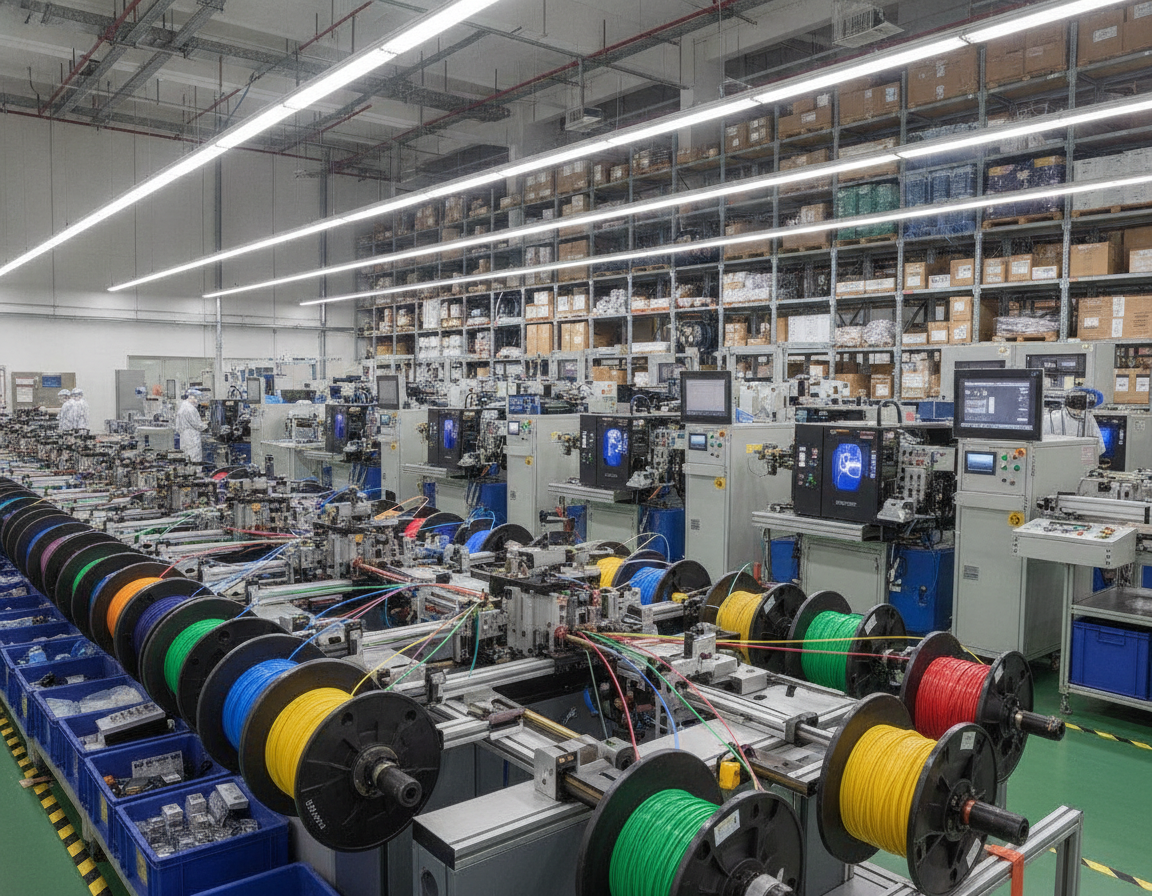 FTTH Cable Production Line
An FTTH cable production line is a coordinated group of machines that converts raw materials into fiber-to-the-home cables. This process meticulously controls fiber tension, coating thickness, and cable geometry, ensuring precise material placement at each stage.
Communication and computer networks depend on cables with consistent dimensions and accurately positioned fibers. The production line integrates various systems, including fiber payoff, coloring, buffering, stranding, extrusion, cooling, testing, and take-up, within a unified, controlled framework.
Purpose Of An FTTH Cable Manufacturing System
The primary objective of such a system is to safeguard the delicate glass fibers while maintaining their optical performance. By regulating tension, it prevents stress during the manufacturing process. The application of a consistent coating and precise jacket geometry facilitates smooth installation and ensures long-term signal transmission fidelity.
Modern FTTH drop cable lines can produce several designs, including flat and round drop cables, simplex cables, duplex soft cables, and tight-buffered cables. These systems offer flexibility, allowing manufacturers to customize production based on fiber count, jacket materials, strength members, and final diameters.
Common FTTH Cable Structures And Applications
Indoor fiber optic cable lines cater to a range of applications, from premises wiring to FTTA and FTTB deployments, local-area networks, patching environments, and building distribution. The common configurations include GJFJV, GJFV, simplex, duplex, and tight-buffered cables, each tailored for specific indoor use cases.
Outdoor networks require protection from moisture, pulling forces, crushing, temperature changes, and ultraviolet radiation. The manufacturing of outdoor cables encompasses a variety of designs, including ADSS, ASU, GYXTC8S, GYXTPY, GYXTW, armored, loose-tube, aerial, duct, and direct-buried cables, each designed for specific outdoor applications.
Different cable structures are intended for particular installation conditions. Tight-buffered cables are ideal for indoor handling, while loose-tube designs accommodate fiber movement due to temperature variations. Armored cables, with their added protection, are suited for challenging routes.
How Production Quality Affects Network Performance
Fiber cable quality directly affects attenuation, tensile strength, crush resistance, bending performance, and environmental durability. Inadequate fiber positioning or uneven coating can significantly increase signal loss. Weak jackets, conversely, may lead to damage during handling, bending, or installation.
Dimensional inspections, tension monitoring, optical measurements, and mechanical tests are important for producing consistent cable. Standards like IEC 60794 provide critical benchmarks for cable performance. ITU-T G.652D and G.657A1/A2 guidelines further specify fiber characteristics for standard, bend-sensitive, and access network applications.
Reliable manufacturing improves installation efficiency and supports stable service throughout the cable’s working life. For network operators, the reliability of production directly correlates with reduced field issues, expedited deployment, and dependable high-speed connectivity.
Essential Modules In Fiber Optic Cable Manufacturing Equipment
Every manufacturing stage helps protect the fiber and control its position. The process ensures accurate payout, alignment, and tension, preventing bends, scratches, and signal loss. These steps are critical in preparing the fiber for the subsequent cable assembly stages.
Fiber Preparation And Coloring Machinery
The initial stages of fiber preparation involve guiding each strand from the payoff reel with precise tension control. Alignment systems are integral in maintaining the fiber’s central position as it traverses the manufacturing line. Surface protection mechanisms are implemented to minimize damage during the coloring, buffering, and cable assembly processes.
A specialized fiber coloring machine is responsible for applying distinct color coatings to each strand. These colors are essential for quick identification during the assembly and field termination phases. Some systems boast up to 12 coloring channels and UV curing speeds exceeding 1,500 meters per minute.
A fiber draw tower creates optical fiber from glass preforms. While it plays a significant role in broader fiber manufacturing operations, most FTTH cable lines utilize pre-manufactured optical fiber.
Secondary Coating And Buffering Systems
The secondary coating line forms loose tubes around one or more fibers, utilizing either dry materials or a jelly-filled compound. This protective layer adds space, enhances protection, and allows for the fiber’s free movement within the cable.
The OFC 40 Secondary Coating Line is designed for high-speed production, ensuring stable excess fiber length and consistent tube quality. These features are vital in maintaining cable dimensions during subsequent stranding and sheathing processes.
Tight-buffering machinery places a close-fitting polymer layer around the fiber, making it suitable for indoor cables requiring easy handling and direct termination. The choice of buffer type is contingent upon the cable’s structure, installation requirements, and necessary protection levels.
Stranding, Extrusion, And Sheathing Units
Stranding machinery organizes tubes, ribbons, or other elements around the core while controlling lay length and core shape. This process ensures stable cable geometry during pulling and installation, critical for maintaining performance.
Extrusion and sheathing units place protective jackets on cables intended for indoor or outdoor use. Common materials include PE, PVC, and LSZH. Temperature, pressure, and cooling control are essential in producing a smooth, accurately dimensioned jacket.
Complete optical fiber cable-making systems may include steel tape or wire armoring equipment. Yarn application, tape wrapping, and cable testing are integral components of these lines. These modules enable manufacturers to tailor protection levels to various applications, including aerial, buried, indoor, and direct-burial installations.
| Production Module |
Main Function |
Typical Production Value |
| Fiber preparation |
Controls payout, alignment, tension, and surface protection |
Helps reduce fiber damage before assembly |
| Fiber coloring machine |
Applies color coatings for fiber identification |
Up to 12 channels and UV curing above 1,500 meters per minute |
| Fiber draw tower |
Draws optical fiber from preforms |
Generally used for fiber manufacturing rather than standard FTTH cable lines |
| Fiber secondary coating line |
Forms dry or jelly-filled loose tubes |
Maintains excess fiber length and consistent tube dimensions |
| Tight-buffering equipment |
Places a close-fitting polymer layer around the fiber |
Helps produce compact indoor cables |
| Stranding unit |
Organizes tubes, ribbons, or cable elements around the core |
Supports controlled lay length and stable cable shape |
| Extrusion and sheathing unit |
Places PE, PVC, or LSZH protective jackets |
Provides protection for indoor and outdoor installations |
| Armoring and testing modules |
Provides steel armor, yarn, tape, and testing functions |
Supports demanding routes and documented quality checks |
FTTH Cable Production Line Configuration Options
Fiber cable factories can be designed around one product or several cable families. The optimal setup hinges on cable structure, fiber count, materials, production speed, and testing requirements. A modular design facilitates manufacturers in balancing output, floor space, and future growth prospects.
Indoor And Drop Cable Configurations
A typical FTTH drop cable production line integrates fiber payout, coloring or identification, strength-member handling, extrusion, cooling, take-up, and inline inspection. This sequence ensures stable dimensions and precise fiber placement. It accommodates common drop cable designs for residential, commercial, and access networks.
An indoor cable production line can produce simplex, duplex, GJFV, GJFJV, tight-buffered, premises, and soft cable designs. It employs aramid yarn, fiberglass rods, or other strength members. Material selection is contingent upon bend performance, pulling force, flame behavior, and installation conditions.
The OFC 43 Premises Cable Extrusion Line supports both indoor and FTTH designs. Its process encompasses stranding, yarn application, and extrusion. This adaptable layout enables a plant to transition between small premises cables and selected access cable designs with minimal production adjustments.
Outdoor Loose-Tube And Armored Cable Configurations
An outdoor fiber optic cable line commences with secondary coating. The process then involves SZ stranding, strength-member application, water-blocking materials when necessary, and final jacketing. These steps safeguard fibers against moisture, tension, temperature fluctuations, and movement during installation.
The OFC 40, OFC 70, and OFC 60 sequence includes three main stages: loose-tube production, SZ stranding, and final jacketing. Each stage is customizable to match the target core count, tube design, cable diameter, and jacket material. Inline controls ensure consistent tube size and cable geometry across extended production runs.
Armored designs incorporate steel tape or steel wire wrapping for enhanced mechanical protection. Adjustable tension prevents gaps, deformation, and excessive pressure on the cable core. This configuration is suitable for direct-burial, duct, industrial, and other demanding outdoor applications.
Customized Production Lines For Cable Requirements
Custom configuration begins with the product drawing. Engineers scrutinize core count, fiber type, cable diameter, sheath material, production speed, quality standards, and plant layout. This review determines the necessary payoffs, extruders, stranders, cooling systems, take-ups, and inspection devices.
Manufacturers can opt for individual process modules or a complete turnkey fiber optic cable production line. A plant may require one extrusion unit for a focused product range. Larger facilities might integrate coloring, buffering, stranding, armoring, jacketing, and testing equipment.
An advanced FTTH cable extrusion line can support newer materials, closer tolerances, and quicker changeovers. Existing lines can be upgraded with newer controls, improved cooling, modern inspection tools, or efficient drives. These enhancements extend service life, boost productivity, and maintain competitiveness.
Teams planning FTTH cable production should compare expected output with product variety and available factory space. A well-matched configuration minimizes material waste and ensures stable, repeatable production.
| Cable Configuration |
Main Process Modules |
Common Applications |
Main Design Priority |
| FTTH drop cable |
Fiber payout, identification, strength-member handling, extrusion, cooling, take-up, inline inspection |
Access drops and short subscriber connections |
Small diameter, bend performance, accurate fiber placement |
| Indoor cable |
Fiber payout, tight buffering, yarn application, extrusion, cooling, take-up |
Simplex, duplex, GJFV, GJFJV, premises, soft, and tight-buffered designs |
Flexibility, flame behavior, and easy installation |
| Outdoor loose-tube cable |
Secondary coating, SZ stranding, strength-member application, water blocking, jacketing |
Duct, aerial, direct-burial, and access network cables |
Moisture protection, tensile strength, and temperature stability |
| Armored fiber cable |
Loose-tube or stranded core, steel tape or wire wrapping, and final jacketing |
Industrial, direct-burial, and high-protection installations |
Controlled armor tension and mechanical protection |
| Customized turnkey line |
Individual modules or a complete integrated manufacturing system |
Special cable designs and varied product portfolios |
Product drawings, speed, standards, layout, and upgrade path |
Fiber Coloring, Secondary Coating, And Tight Buffering Processes
The journey of fiber production commences with either bare fiber or a primary-coated variant, distinguished by its 250 µm coating. A specialized fiber coloring machine then applies a precise, thin layer to each fiber within a multi-fiber cable. This meticulous process ensures swift identification during the subsequent splicing and installation phases.
Modern coloring systems can process as many as 12 channels at the same time. Utilizing UV curing equipment, the color layer is solidified at velocities exceeding 1,500 meters per minute. Ensuring stable fiber tension, uniform ink flow, and consistent curing processes are imperative to avert irregular coloration, surface imperfections, and damage to the fiber.
After coloring, a secondary coating line places one or more fibers inside a protective tube. This line can generate either dry loose tubes or jelly-filled counterparts. Each configuration necessitates a stable excess fiber length, accommodating variations in temperature and mechanical stress.
Tube dimensions must remain consistent during extrusion, cooling, and post-shrinkage. Maintaining a consistent tube profile is critical for preserving the cable’s geometry and mitigating stress on the optical fiber. Achieving precise material flow and controlled cooling is essential to minimize dimensional discrepancies across extended production periods.
Tight buffering is an important process for producing indoor and FTTH cables. It encompasses the formation of tight-buffered fibers, semi-tight buffers, and micro-sheath products. Hytrel, PVC, and LSZH are commonly employed as buffer materials, with tight-buffer layers produced within a 600–900 µm extrusion range.
Water troughs cool the newly formed buffer layer and remove excess heat. Subsequent UV drying or curing may be necessary, contingent upon the material system’s requirements. These steps are critical for stabilizing the final profile and facilitating clean winding, connector preparation, and cable assembly.
Process control integrates fiber tension, material temperature, die alignment, curing conditions, and take-up speed. Operators meticulously monitor these parameters to minimize the occurrence of bubbles, ovality, surface defects, and excess scrap. Achieving a harmonious process balance is essential for safeguarding the fiber while maintaining the cable’s optical integrity.
SZ Stranding Technology For FTTH And Outdoor Fiber Cables
An SZ stranding line places tubes, ribbons, or other cable elements around a central core while changing the lay direction at set intervals. This method facilitates the creation of flexible cable geometries and controlled core formations.
The alternating lay directions within the cable allow for the fibers to move freely. This movement aids in managing strain during bending, pulling, and temperature fluctuations. Such a technique is predominantly employed for outdoor applications and in the production of dense fiber cable cores.
How SZ Stranding Works
The SZ stranding process involves the use of payout units to guide tubes or ribbons towards a central strength member. The stranding head, rotating around the core, changes direction at intervals determined by the lay length. A binding unit secures the elements in place before they reach the take-up system.
The OFC 70 SZ-Stranding Line is engineered for high-speed stranding of various cable elements. It supports controlled lay lengths, precise binding, and accommodates long production batches. Depending on the configuration, it can handle up to 24 fibers, with rotation speeds reaching 3,000 rpm.
Advantages Of Servo-Controlled Stranding
Servo-controlled stranding synchronizes payout, rotation, binding, and take-up systems. Each servo motor adjusts to production settings in real-time. This synchronization enhances lay-length accuracy and maintains consistent binding tension.
Stable synchronization contributes to a uniform cable diameter, reducing fiber stress. It facilitates smoother handling during extrusion and sheathing processes. The consistent core geometry ensures reliable optical performance across extended production runs.
- Precise lay length for stable core construction
- Balanced tension across tubes and ribbons
- Synchronized take-up for steady production
- Lower risk of fiber movement and excess strain
- Improved process control during high-speed production
When To Use SZ Stranding In An FTTH Facility
SZ stranding suits outdoor loose-tube cables, ribbon-based designs, and cable cores containing many organized elements. It offers manufacturers a flexible platform for producing high-count products, trunk cables, and network cables for challenging routes.
A facility producing only basic FTTH drop cables may not need a complete SZ stranding line. Diversified plants, on the other hand, can use the equipment for expansion into outdoor cables, high-density products, and longer production batches.
SZ super-bundling is a related method that combines rollable ribbon bundles into organized super bundles. These bundles are suitable for compact datacenter interconnect cables, where fiber density, flexibility, and organized routing are critical.
Fiber Cable Extrusion And Sheathing For FTTH Protection
Extrusion applies an outer jacket to the fiber cable, helping protect it from moisture, abrasion, and other environmental conditions. The jacket must endure exposure to sunlight, temperature fluctuations, and other outdoor elements. A well-controlled extrusion process ensures the cable’s performance remains stable from the manufacturing stage to its deployment.
Jacket Materials Used For Indoor And Outdoor Cables
Polyethylene (PE) is commonly selected for outdoor jackets because it resists water and weather conditions. This makes PE fiber cable jackets ideal for direct burial, aerial, and duct applications. The material can be customized for enhanced flexibility, strength, and environmental resilience.
PVC and LSZH materials are favored for indoor cable designs. PVC supports durable jackets and buffer layers, suitable for general building applications. LSZH fiber cable production is preferred where low smoke and reduced halogen emissions are critical during fires.
Hytrel is used in tight-buffer applications that require flexibility and reliable recovery. PVC and LSZH can also serve as buffer or jacket materials, depending on the cable’s structure. The OFC 60 Jacketing Line is designed for the final outdoor protection and flexible cable designs. It operates at a sheathing speed of approximately 60–90 meters per minute, contingent on cable diameter, material, and configuration.
Cooling, Curing, And Dimensional Control
Once the polymer leaves the die, cooling troughs stabilize the extruded shape. Maintaining consistent water temperature, flow rate, and contact time is essential. These factors are critical in preserving the jacket’s diameter and minimizing surface defects.
UV dryers or curing systems may support compatible coating and marking processes. Integrating energy-saving extrusion and UV-curing technologies can significantly reduce operating costs. A well-controlled line ensures high output without compromising the fiber core.
An advanced FTTH cable extrusion line uses sensors and control systems to regulate important process points. Parameters such as die centering, melt temperature, extrusion pressure, line speed, cooling-water stability, jacket concentricity, and take-up tension all impact cable quality. Even minor adjustments in these settings can affect wall thickness and cable flexibility.
Factors Affecting Fiber Cable Sheathing Performance
A fiber cable sheathing line must align with the planned cable range, polymer types, and target output. The design of the screw, crosshead accuracy, cooling length, haul-off control, and take-up capacity all influence stable production. The line should facilitate quick size changes, accommodating multiple FTTH cable designs in a factory setting.
Every jacket should be checked for diameter, ovality, surface finish, adhesion, tensile strength, and elongation. Environmental tests assess resistance to heat, moisture, chemicals, sunlight, and repeated bending. These evaluations confirm the jacket’s effectiveness in protecting the cable during installation and service.
- Outdoor designs often use PE for moisture and weather resistance.
- Indoor cables may use PVC for durability and straightforward processing.
- LSZH materials suit locations with strict smoke and halogen limits.
- Tight-buffer cables may use Hytrel for added flexibility and recovery.
- Servo-controlled take-up systems help maintain consistent tension and cable diameter.
| Application |
Common Material |
Main Protection Need |
Key Process Checks |
| Outdoor FTTH cable |
PE |
Protection from moisture, sunlight, abrasion, and temperature variation |
Wall thickness, concentricity, cooling stability, and jacket finish |
| Indoor distribution cable |
Polyvinyl chloride |
Flexibility, abrasion protection, and simple installation |
Diameter, ovality, tensile strength, and take-up tension |
| Low-smoke indoor cable |
LSZH |
Reduced smoke and halogen emissions during fire |
Melt control, surface quality, elongation, and flame-related testing |
| Tight-buffered fiber cable |
Hytrel, PVC, or LSZH materials |
Flexibility, fiber protection, and predictable stripping |
Buffer fit, adhesion, recovery, diameter, and bending performance |
Fiber Ribbon Line And Compact Fiber Unit Solutions
Ribbon production arranges several optical fibers in a flat and organized structure. This method increases fiber density and facilitates rapid mass splicing in high-count cables. It is ideal for datacenter links, central-tube cables, and other space-constrained networks.
Ribbon-Based Cable Production
The OFC 45 Ribbon Buffering Line generates dry and jelly-filled ribbon tubes. These tubes are designed for central-tube and ribbon-based loose-tube cable structures. Controlled buffering safeguards the fibers while maintaining the tube’s compactness, preparing it for subsequent stranding or jacketing.
Rollable ribbon production is essential for next-generation datacom systems. The OFC 23 Rollable Ribbon Line creates high-density rollable ribbons for datacenter cable designs. Their flexible nature allows for increased fiber density within a limited cable diameter.
The OFC 79 Rollable Ribbon Bundling Line assembles these ribbons into compact, cable-ready bundles. The OFC 70 SZ Super-Bundling Line then combines these bundles into structured super bundles for datacenter interconnect cable cores. An OFC 60 Jacketing Line can apply the final jacketing.
Fiber Ribbon And “Fiber Ribbone Line” Search Terminology
Fiber ribbone line is a common search variation for fiber ribbon line. Despite the spelling variation, the technical process remains focused on ribbon production, buffering, bundling, or tube formation. The essence lies in the process control, not the spelling used in product searches.
Compact Fiber Unit Integration
A compact fiber unit integrates one or more fibers, ribbons, strength members, and protective layers into a single, small subassembly. This format supports modular production and space-efficient cable designs. It enables a higher fiber count within restricted cable dimensions.
Compact units are useful in high-density datacom manufacturing because they support flexible product layouts. They can navigate through subsequent bundling, stranding, and jacketing stages with minimal adjustments to the main line. This approach facilitates the production of specialized designs without significantly increasing floor space requirements.
Automation, Testing, And Production Quality Control
Ensuring the reliability of cable production necessitates a steadfast control mechanism, precise test data, and swift fault detection. A contemporary PLC fiber cable production line integrates each phase, from fiber payout to the final cable take-up. This configuration ensures consistent output over extended periods and facilitates uninterrupted operation around the clock.
PLC And HMI Control Systems
A Siemens PLC and HMI system can coordinate the complete production process from payout through take-up. It synchronizes line speed and material flow across all units, ensuring a seamless operation. The HMI interface empowers operators to access recipes, review alarm histories, monitor process values, and initiate emergency stops.
Correct fiber path alignment is essential for protecting the glass fiber as it moves through the line. Maintaining stable tension is equally important to prevent excessive attenuation, microbending, fiber breaks, and irregular cable geometry. The system allows for the saving of settings for various cable designs, including drop, indoor, and outdoor cables.
Optical And Mechanical Cable Testing
Optical fiber cable testing encompasses assessments of attenuation and continuity, as well as transmission performance and fiber identification. These evaluations confirm that each fiber adheres to the specified path and meets performance criteria. Automated testing records are linked to production batches, providing a clear audit trail.
A dedicated testing station may assess optical attenuation, tensile strength, crush resistance, and aging. Mechanical inspections cover tensile strength, crush resistance, heat aging, jacket condition, and dimensional accuracy. The selection of tests must align with the cable’s structure, jacket material, strength member, and intended installation environment.
Quality assurance starts by checking incoming optical fibers, polymer compounds, and strength members. It extends to the evaluation of finished cable dimensions, optical performance, jacket condition, and production records. Continuous monitoring alerts operators to any deviations from set limits, enabling prompt corrective actions.
Relevant Fiber And Cable Standards
Manufacturers rely on IEC 60794 as a primary reference for optical fiber cable specifications. Fiber characteristics may adhere to ITU-T G.652D for standard single-mode designs or ITU-T G.657A1 or ITU-T G.657A2 for bend-insensitive applications. The chosen fiber class must align with the cable’s structure and the network’s requirements.
Documentation may reference ISO 9001 quality systems, CE marking, and RoHS compliance. These references underscore the commitment to traceable production practices and responsible material selection. The test plan should reflect customer specifications, local regulations, and the cable’s intended use.
| Quality Control Area |
Primary Functions |
Quality Value |
| PLC And HMI |
Line synchronization, recipes, alarms, emergency stops, and process monitoring |
Consistent operation and repeatable production settings |
| Fiber Handling |
Path alignment, payout control, and tension regulation |
Reduced risk of attenuation, microbending, and fiber breaks |
| Optical Performance Testing |
Attenuation, continuity, transmission, and fiber identification testing |
Confirmed optical performance |
| Mechanical Performance Testing |
Tensile, crush, aging, jacket, and dimensional inspections |
Improved durability and cable consistency |
| Standards Control |
IEC 60794, ITU-T G.652D, ITU-T G.657A1, and ITU-T G.657A2 references |
Clear design and compliance targets |
Choosing Efficient Fiber Optic Cable Manufacturing Equipment
Begin equipment selection by reviewing the planned cable portfolio rather than focusing only on individual machines. Determine the plant’s production scope, encompassing various cable types such as drop, indoor, outdoor, and others. This approach ensures that the FTTH cable equipment selection is precise, avoiding costly production capability gaps.
Production Output And Line Speed
Align output with forecasted demand, considering speed as a secondary factor. Coating and extrusion units can achieve speeds up to 1,000 meters per minute. In contrast, sheathing lines operate at approximately 60–90 meters per minute. The overall line output is determined by the slowest process, changeover time, and reel handling efficiency.
Assess fiber count, core diameter, cable diameter, lay length, material flow, take-up reel size, and setup time. High-speed fiber cable production lines must maintain consistent tension across all speeds. Request test data specific to the cable designs intended for the plant.
| Assessment Area |
Reason It Matters |
What To Verify |
| Line Speed |
Influences daily output and process balance |
Rated speed, normal operating speed, and loaded speed |
| Fiber Capacity |
Supports current and future cable designs |
Core count, fiber type, and supported diameter range |
| Product Changeover Time |
Affects small-batch production |
Tool changes, recipe storage, and reel exchange |
| Material Throughput |
Controls jacket and buffer consistency |
Resin flow, cooling requirements, and material waste |
Materials, Cable Range, And Future Upgrades
Confirm that the optical fiber cable-making machinery supports both single-mode and multimode fibers. The system should accommodate various fiber types, including G.652D and G.657A1/A2. Verify compatibility with materials such as Hytrel, PVC, LSZH, PE, steel tape, and wire armor.
A modular cable production line can integrate multiple processes like fiber coloring, OFC 40 secondary coating, and OFC 60 jacketing. Request customization based on product drawings, core count, target speed, sheath materials, and required standards.
Modular equipment makes later expansion easier. Adding new buffering, stranding, or jacketing units can extend the life of existing equipment. This flexibility supports adapting to changing orders without replacing the entire fiber optic cable line.
Factory Space, Energy Consumption, And Maintenance
Review the factory before purchasing the equipment. Many systems require a 380 V AC ±10%, three-phase industrial supply. Power consumption may approach about 55 kW, depending on the configuration. Confirm the necessary floor space, material flow, reel movement, ventilation, cooling water, operator access, safety clearances, and expansion space.
Compare energy-efficient extrusion units and UV-curing systems with the products planned for manufacture. Review preventive maintenance tasks, cleaning needs, spare-parts access, and service clearance around each module. Clear records and easy access are essential for maintaining the productivity of optical fiber cable-making machines during extended production periods.
A well-planned purchase integrates capacity, materials, layout, energy use, and service support. These considerations form a solid foundation for reliable FTTH production, avoiding unnecessary expenses on unused speed or features.
Installation, Training, And Support For FTTH Cable Manufacturing
Reliable FTTH cable line installation begins with a carefully prepared factory plan. Suppliers must meticulously assess the floor area, production flow, access routes, and safety zones prior to equipment delivery. This foundational plan dictates the precise positioning of equipment, ensuring seamless coordination with utilities, line assembly, and cable routing.
Commissioning includes essential steps such as power checks, air and water connections, control-system setup, and process calibration. Engineers are dispatched upon equipment arrival, aligning with the equipment’s complexity, site readiness, and customer needs. Initial production verification is imperative to validate output quality before transitioning to regular operations.
Opting for a turnkey cable production system encompasses more than just equipment delivery. It includes layout design, installation support, operator training, and detailed technical documentation. These documents are indispensable, detailing machine settings, wiring diagrams, operational procedures, maintenance tasks, and safety protocols. Such documentation is instrumental in minimizing downtime and ensuring efficient production management.
Good training for fiber optic cable machinery should combine technical instruction with hands-on practice. Operators must be proficient in handling fibers, loading materials, setting recipes, adjusting tension, and conducting extrusion, stranding, and cable testing. Training should also encompass routine cleaning, safe operation, alarm monitoring, and basic troubleshooting techniques.
Training modalities can vary, with on-site sessions providing hands-on experience and remote sessions facilitating review of control screens, recipes, and standard operating procedures. This dual approach ensures that operators are well-prepared to handle the complexities of the equipment.
- Check fiber routing, tension control, and material-feed settings.
- Review extrusion temperature, line speed, cooling, and jacket dimensions.
- Inspect stranding settings, test results, and production records.
- Practice safe shutdown, cleaning, inspection, and fault recovery.
Remote technical support is invaluable for addressing software settings, program faults, sensor alarms, and machinery malfunctions. A dedicated service team can review operational data, guide diagnostic procedures, and provide replacement support when necessary. Timely response is critical, given the operational demands of a production line serving active customer orders.
Preventive maintenance should include cleaning, lubrication, electrical inspections, calibration checks, and wear-part reviews. Modular equipment typically follows a maintenance cycle of approximately six months. The actual interval, influenced by operating hours, materials, dust levels, line speed, and site conditions, should be clearly outlined in a service plan.
| Service Area |
Details To Confirm Before Purchase |
| After-Sales Response |
Support hours, response targets, escalation procedures, and communication methods |
| Replacement Parts |
Stock location, delivery times, compatible parts, and replacement instructions |
| Software Support |
Program backups, updates, access rights, and remote diagnostic options |
| Warranty |
Warranty period, exclusions, labor terms, and claims procedure |
| Regional Service |
Regional engineers, travel assistance, and available maintenance coverage |
Platforms like Made-in-China.com Secured Trading offer additional security features, including payment protection, shipment tracking, optional pre-shipment inspections, and dispute resolution assistance. It is imperative to confirm details such as freight costs, delivery dates, warranty coverage, and service conditions directly with the chosen supplier.
Benefits Of Advanced FTTH Cable Manufacturing Technology
Modern production systems give manufacturers precise control from fiber pay-off through to final jacketing. The integration of automated tension control, synchronized drives, stable extrusion, controlled curing, and precise stranding ensures the maintenance of cable dimensions and optical performance. This level of precision is critical for the production of advanced FTTH cables, catering to the demands of complex network projects.
Consistent Cable Quality And Lower Production Waste
Precise process control helps maintain stable excess fiber length throughout cable production. This control supports controlled post-shrinkage, accurate lay length, precise binding, and repeatable jacket dimensions. Such factors are essential in reducing stress on the fiber, ultimately protecting signal quality during both installation and service.
Stable line control can reduce fiber breaks, material waste, and rework. It allows for more predictable output across extended production runs. The adoption of energy-saving extrusion systems and UV-curing technology further contributes to lowering operational costs, aligning with the goal of low-waste cable production.
Adaptable Manufacturing For Changing Demand
A well-configured line can produce a diverse range of cables, including indoor, outdoor, FTTH, armored, ribbon, loose-tube, and tight-buffered varieties. The same equipment platform can also support datacom, hybrid, and composite designs with the addition of specific process modules. This adaptability enables manufacturers to respond to shifts in local broadband, data center, and enterprise network demands.
Individual process steps can be installed incrementally, allowing for expansion as orders increase. Modular equipment supports various functionalities, including rollable ribbon, fiber bundling, SZ super-bundling, and final jacketing. These capabilities cater to both high-density data center interconnect cables and standard FTTH products.
Modular upgrades can modernize older lines without necessitating the replacement of every machine. New controls, drives, tension systems, and testing units can extend the service life of equipment and enhance productivity. This strategy safeguards existing investments while pursuing the latest advancements in fiber cable manufacturing technology.
Scalable Equipment For High-Speed Fiber Cable Manufacturing
Industrial systems built for long production runs and continuous operation can raise output while preserving process stability. Automated line synchronization ensures that pay-off, stranding, extrusion, curing, and take-up units operate at a consistent pace. These features are essential for high-speed fiber cable production, facilitating large-scale network deployments.
Optimal FTTH cable production solutions extend beyond merely fast machinery. They encompass operator training, global installation support, process guidance, and lifetime technical assistance from the supplier. Skilled teams can promptly identify process changes, ensuring reliable production over time.
Scalable equipment allows manufacturers to align production capacity, cable quality, and future network demand. This alignment provides a practical framework for growth across residential broadband, enterprise systems, and high-density fiber infrastructure.
Conclusion
A modern FTTH Cable Production Line combines fiber preparation, coloring, secondary coating, buffering, stranding, extrusion, sheathing, testing, and automation in one coordinated workflow. Each phase ensures stable optical performance, precise dimensions, and reliable cable protection.
The selection of the appropriate setup hinges on cable design, fiber count, materials, adherence to standards, production volume, available factory space, and future expansion plans. Essential components include a fiber coloring machine, a fiber secondary coating line, a tight buffering line, an SZ stranding line, an advanced FTTH cable extrusion line, a fiber cable sheathing line, a fiber ribbon line, and compact fiber unit solutions.
Manufacturers must focus on maintaining controlled fiber tension, utilizing reliable materials, implementing automated monitoring, and conducting thorough quality tests. Optimal FTTH cable production solutions might encompass single process modules or complete turnkey systems, catering to various cable types such as indoor, outdoor, FTTH, armored, ribbon, and high-density datacom cables.
Using suitable fiber optic cable manufacturing equipment can improve production output while reducing waste. Scalable, upgradeable systems are instrumental in ensuring reliable broadband deployment, fortifying FTTH network manufacturing, and fostering long-term competitiveness.
Related: VOC Emissions Reduction from Fiber Coloring Operations
Fastenerless Guards for a Fiber Cable Sheathing Line
 CNC Machining in Houston